





Published Wednesday, November 25, 2026 by Fairfield Furbabies
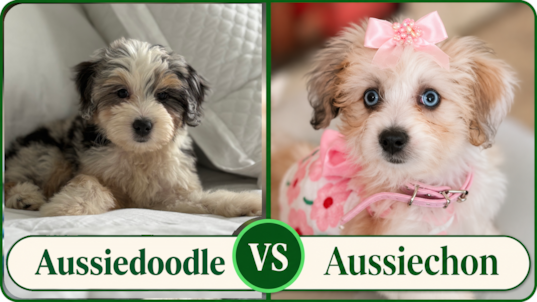
The Mini Aussiedoodle vs Aussiechon comparison is particularly interesting because these two adorable dogs share more than their beautiful coats and expressive faces. Both have Mini Australian Shepherd ancestry, which contributes to their intelligence, alertness, and enthusiasm for human interaction. They can be affectionate, playful, quick to learn, and wonderfully entertaining companions. Yet beneath those similarities are some meaningful differences, especially in how much activity they need and what they expect from everyday life.
The Mini Aussiedoodle has a reputation for its sharp mind, athletic nature, and enthusiasm for activities that challenge both body and brain. The Aussiechon shares that cleverness but tends to have a more socially playful personality, with an affectionate nature that appeals to families and individuals alike. A Mini Aussiedoodle may be particularly interested in figuring out what you're asking it to do, while an Aussiechon may be just as interested in the fun everyone is having. These tendencies don't describe every individual dog, but they offer a useful starting point for understanding the breeds.
Their appearances are worth a closer look, too. Both can inherit striking merle patterns, bright blue eyes, and soft coats that range from waves to curls. However, Mini Aussiedoodles tend to have a more athletic outline, while Aussiechons can display a compact, plush appearance that makes them look like little stuffed animals. Size ranges overlap considerably, so the differences are not always obvious in puppy photographs.
For someone who loves active, intelligent companion dogs, either breed can be tempting. The important question is how each one will fit into your home after the excitement of bringing home a puppy settles into ordinary life. We'll explore their history, appearance, temperament, grooming needs, and daily routines to help you understand what makes each breed special. By the end, you'll have a clearer idea of which dog suits your lifestyle, experience, and expectations.
Table of Contents
Mini Aussiedoodle vs Aussiechon Comparison Table
The Mini Aussiedoodle and Aussiechon share their Mini Aussie ancestry, but their other parent breeds contribute different qualities. The Mini Aussiedoodle combines the Mini Aussie with the Poodle, while the Aussiechon combines it with the Bichon Frise. Both are intelligent and affectionate, although the Mini Aussiedoodle tends to have higher exercise demands. Their coats and adult sizes also vary, so the table below provides a useful overview of the differences.
| Characteristics | Mini Aussiedoodle | Aussiechon |
| Parent Breeds | Miniature Australian Shepherd (Mini Aussie) × Miniature Poodle | Miniature Australian Shepherd (Mini Aussie) × Bichon Frise |
| Other Names | Miniature Aussiedoodle, Mini Aussiepoo, Mini Aussie Poodle mix | Aussie Bichon mix, Mini Aussie Bichon mix |
| Adult Weight | Approximately 8–25 pounds in smaller lines; some adults are larger | Approximately 8–20 pounds |
| Adult Height | Approximately 12–18 inches | Approximately 10–18 inches |
| Coat Type | Soft, wavy, curly, or loosely textured; variable density | Soft, fluffy, wavy, straight, or curly; frequently plush |
| Hypoallergenic Qualities | Low-shedding potential; no hypoallergenic guarantee | Low-shedding potential; no hypoallergenic guarantee |
| Grooming Needs | Brush 3–4 times weekly or daily for longer coats; professional grooming approximately every 6–8 weeks | Brush 3–4 times weekly or daily for longer coats; regular professional trims as needed |
| Exercise Needs | Approximately 60–90 minutes daily for many active adults | Approximately 30–45 minutes daily for many adults, with additional activity for energetic individuals |
| Training | Highly responsive, quick to learn, enjoys challenging tasks and varied lessons | Intelligent, responsive, playful, learns well through rewards and positive interaction |
| Colors | Blue merle, red merle, black, white, cream, chocolate, apricot, red, and tricolor patterns | Blue merle, red merle, white, cream, black, tan, brown, apricot, and mixed patterns |
| Temperament | Intelligent, energetic, devoted, alert, athletic, affectionate | Clever, cheerful, affectionate, sociable, playful, adaptable |
| Best Fit | Active individuals and families who enjoy training, outdoor activities, and daily mental challenges | Individuals and families who want a clever, playful companion with more moderate exercise needs |
Mini Aussiedoodle vs Aussiechon Overview
Although the Mini Aussiedoodle and Aussiechon belong to the same modern family of companion crosses, their histories have followed somewhat different paths. The Mini Aussiedoodle developed a strong identity among people interested in athletic, trainable Poodle mixes. The Aussiechon attracted attention for its appealing combination of intelligence, sociability, and manageable size. Neither has the centuries-long documented history of an established purebred dog, but both have earned an enthusiastic following.
Mini Aussiedoodle History and Popularity
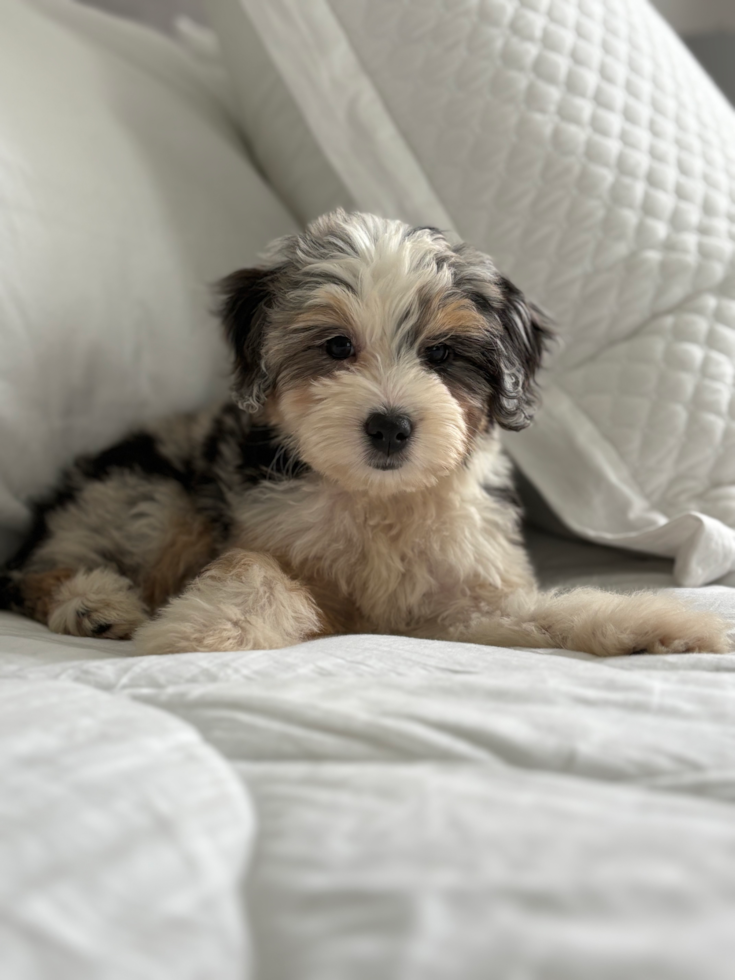
The Mini Aussiedoodle developed during the growth of designer Poodle crosses in the late twentieth century and early 2000s. Breeders sought to combine the intelligence and agility of the Mini Aussie with the coat characteristics and trainability of the Miniature Poodle. The result was a compact companion with a lively personality and an impressive interest in learning. As people began to appreciate smaller dogs that could participate in active family life, the Mini Aussiedoodle found an enthusiastic audience.
Its popularity grew among people who wanted an intelligent dog without the size of a larger working or sporting breed. Mini Aussiedoodles attracted owners who enjoyed hiking, training, interactive games, and other activities that gave their dogs opportunities to participate. Their affectionate nature also made them appealing as family companions, particularly in homes where dogs were included in everyday plans. The combination of athletic ability and a strong interest in people helped distinguish the breed from more relaxed companion crosses.
Appearance contributed to the Mini Aussiedoodle's popularity as well. The breed can display striking color patterns, unusual eye colors, and a wide range of coat textures. That variety makes each puppy visually interesting, although appearance alone tells little about the dog's future activity needs. The Mini Aussiedoodle's lasting appeal comes from its personality: an intelligent, attentive companion that enjoys having something worthwhile to do.
Aussiechon History and Popularity
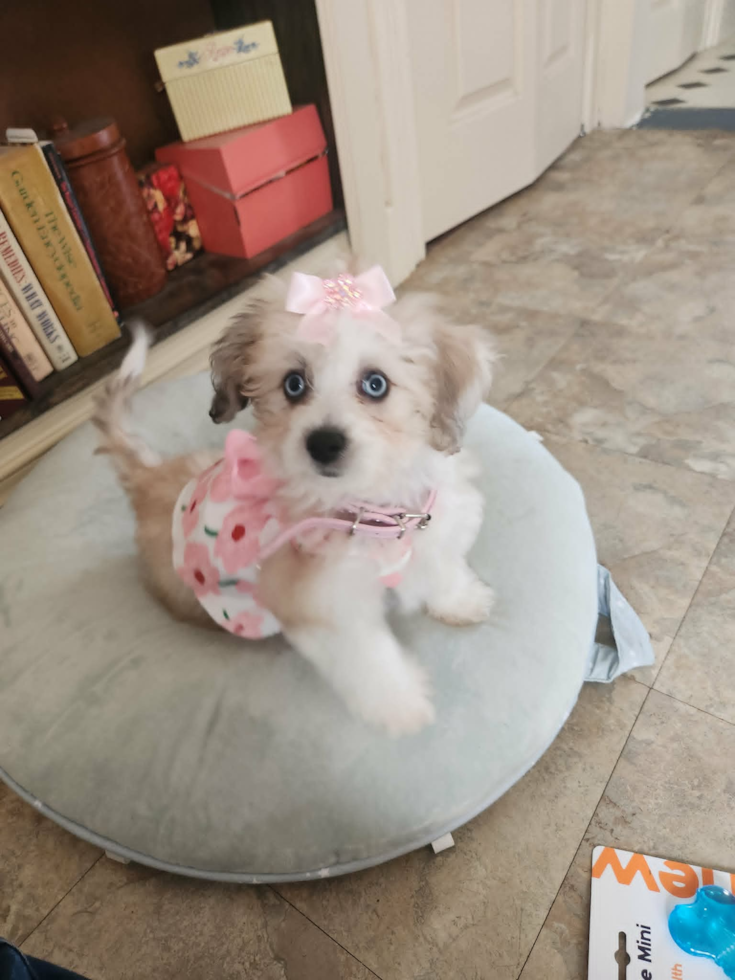
The Aussiechon is a newer designer cross that combines the Mini Aussie and Bichon Frise. Unlike breeds with long-established records, the Aussiechon does not have a widely documented founding date or a single recognized creator. It developed as interest grew in smaller dogs that combined attractive companion qualities with intelligence and playful energy. The cross gradually found an audience among people who appreciated the Mini Aussie's cleverness but also wanted the cheerful, affectionate character associated with the Bichon Frise.
The Aussiechon has gained attention for its approachable personality and distinctive appearance. Some have fluffy white or cream coats, while others display dramatic merle markings or darker color combinations. Their size makes them practical for many households, and their playful nature appeals to people who enjoy interactive pets. The breed has particular appeal for families who want a dog with enthusiasm for activity but may not want the more demanding daily schedule associated with some highly driven crosses.
An important part of the Aussiechon's identity is its balance between playfulness and companionship. These dogs can enjoy outdoor activities, learn new tricks, and participate in family games, but they also appreciate affection and familiar routines. Their popularity reflects a growing interest in intelligent small dogs that offer more than a pretty coat. For people who want a lively companion with a sociable personality, the Aussiechon has qualities that are easy to appreciate.
Mini Aussiedoodle vs Aussiechon Appearance
The Mini Aussiedoodle and Aussiechon are among the more visually interesting small designer dogs because both can inherit the colors and markings associated with the Mini Aussie. A puppy with a blue merle coat and bright eyes can attract attention immediately, regardless of which cross it belongs to. Their soft coats and expressive faces add to that appeal. The more revealing differences appear in their body proportions, coat density, and the way their natural features develop with age.
Mini Aussiedoodle Appearance
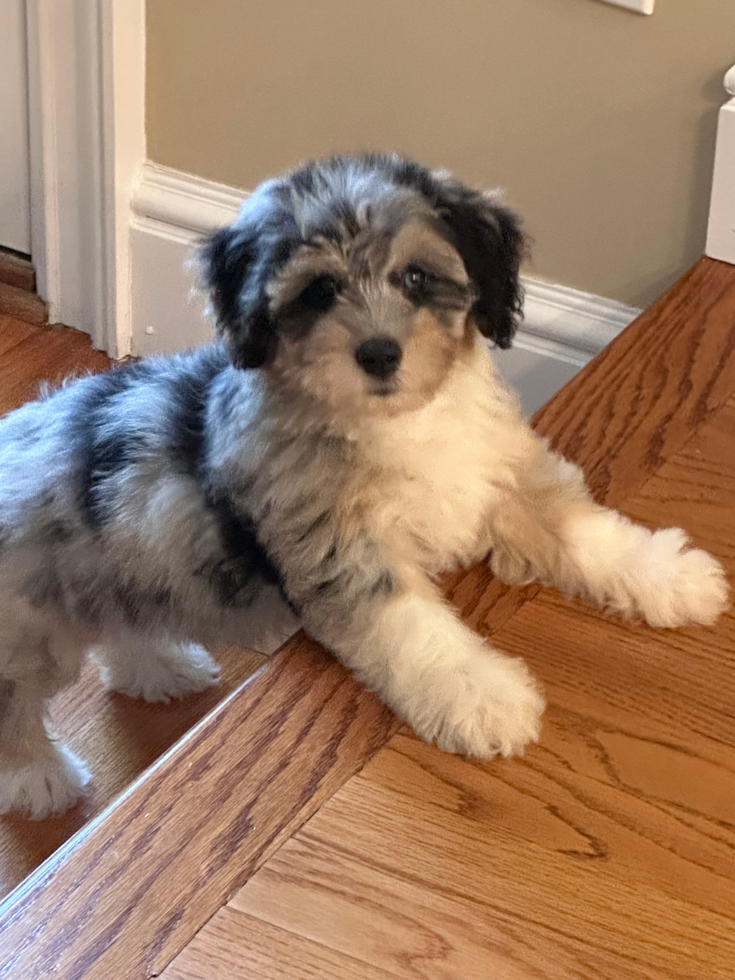
Mini Aussiedoodles tend to have a balanced, athletic build with a body that looks capable of quick, agile movement. Their adult size varies, with smaller lines commonly weighing around 8 to 25 pounds and standing approximately 12 to 18 inches tall. Some adults grow beyond the smaller weight range, particularly when their size lines are larger. Their legs can appear relatively long beneath the coat, and their bodies frequently have a lean, well-proportioned outline. This gives many Mini Aussiedoodles a sporty appearance even when their hair is trimmed into a soft puppy cut.
The coat can take several different forms, which is one reason adult Mini Aussiedoodles do not all look alike. Some develop loose, flowing waves that fall close to the body, while others have tighter curls that create more volume. A few display a softer, less curly texture that allows the body shape to show more clearly. Blue merle and red merle patterns are particularly eye-catching, but black, cream, chocolate, apricot, red, and tricolor combinations also occur. Coat length, texture, and even color intensity can change as the puppy matures.
Mini Aussiedoodles have expressive faces with muzzles that are usually moderate in length. Their ears commonly fold downward, although the exact shape and position vary. Eye color is another distinctive feature, with brown, blue, amber, and mixed-color eyes all possible. Some dogs have two differently colored eyes, while others have subtle variations within the same iris. The tail may carry a soft plume of hair, and the overall expression tends to look alert and attentive.
Grooming requirements depend heavily on the coat's density and texture. A Mini Aussiedoodle with loose waves may need a different brushing routine from one with compact curls, although both require regular attention. Areas beneath the ears, behind the front legs, and around the collar can collect tangles that are difficult to notice from the outside. Brushing several times weekly is important, with daily care preferable for longer coats that knot easily. Professional trims approximately every six to eight weeks help keep the coat comfortable and manageable.
Aussiechon Appearance
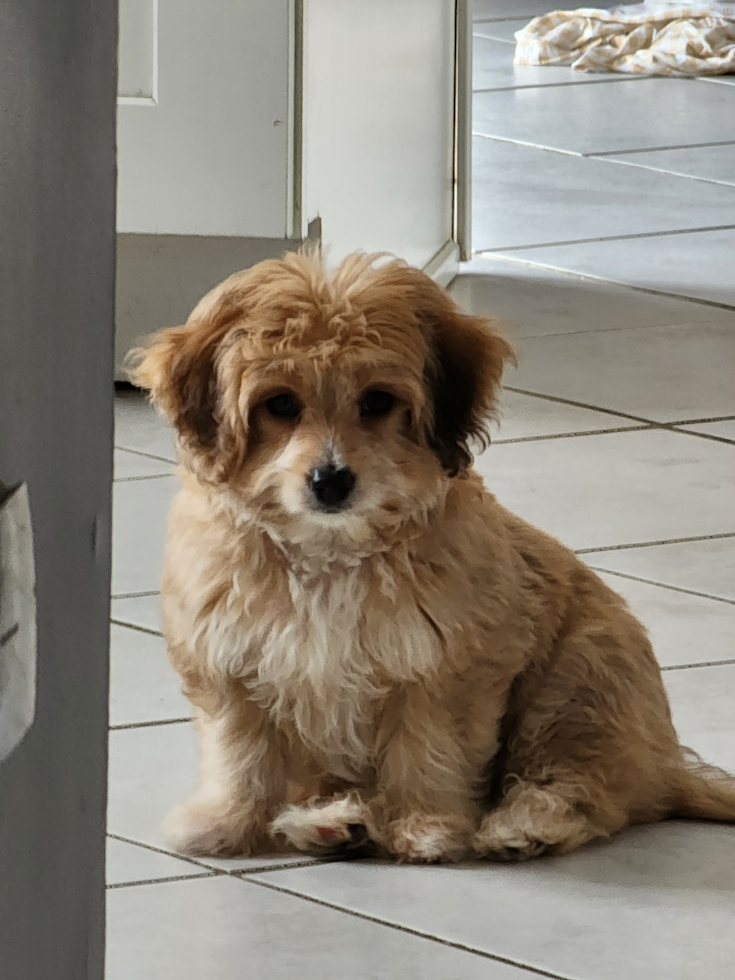
The Aussiechon has a compact, attractive build that can look slightly rounder than the Mini Aussiedoodle's. Adults commonly weigh between 8 and 20 pounds and stand approximately 10 to 18 inches tall. Some have shorter legs and a fuller outline, while others display the leaner proportions associated with the Mini Aussie. Their bodies are typically well balanced, with enough agility to support lively play and regular walks. The size range means an Aussiechon can be a small, easy-to-carry companion or a somewhat taller dog with a more substantial presence.
The Aussiechon coat is especially interesting because it can combine a fluffy, plush appearance with colors that are familiar among Mini Aussie crosses. Some have dense waves that create a rounded silhouette, while others develop a softer, straighter coat or more defined curls. White and cream coats can give them a classic teddy-bear look, but black, tan, chocolate, apricot, and merle patterns bring plenty of variety. A merle Aussiechon may display a mixture of gray, black, white, and tan, while a red merle dog can have warm brown and cream markings. No particular color or pattern is guaranteed simply because a puppy belongs to the cross.
The face is commonly soft and expressive, with a rounded appearance that can be emphasized by the coat. Aussiechons may have a moderately defined muzzle, dark or brown noses, and ears that hang beside the head. Some ears sit a little higher or have a partial fold, which can give the dog a particularly alert expression. Brown eyes are common, although blue or differently colored eyes are possible. A rounded facial trim brings attention to the eyes and nose, while a longer coat creates a more casual, fluffy appearance.
Grooming is an important part of keeping an Aussiechon neat and comfortable. The soft coat can form tangles behind the ears, beneath the front legs, and anywhere the hair experiences regular friction. Brushing three or four times weekly is useful for many dogs, while longer or denser coats may need daily attention. Professional trims can help preserve a practical length, especially for owners who prefer a tidy teddy-bear style. Although the Aussiechon may have a low-shedding coat, that does not make it free of regular grooming needs.
Mini Aussiedoodle vs Aussiechon Appearance Comparison
The main visual difference lies in their overall proportions and coat presentation. A Mini Aussiedoodle may have a longer-legged, more athletic silhouette, particularly when its coat is trimmed short enough to reveal the body. An Aussiechon can have a fuller, more compact appearance, especially when its coat develops a soft, plush texture. Yet these differences are not absolute because both crosses inherit a variety of physical characteristics. A tall Aussiechon and a smaller Mini Aussiedoodle can look remarkably similar in size.
Their colors are even less useful as a way to identify them. Both can display blue merle, red merle, black, white, cream, and mixed patterns because they share Mini Aussie ancestry. Blue eyes and unusual markings can occur in either cross, so those features do not establish that a puppy is a Mini Aussiedoodle rather than an Aussiechon. Coat texture may offer a clue, but there is considerable overlap between wavy, curly, and fluffy coats. The dog's overall build and confirmed breed background provide a clearer distinction.
For future owners, grooming deserves at least as much attention as appearance. A long, curly Mini Aussiedoodle coat can require substantial brushing, while an Aussiechon with fine, fluffy hair may develop tangles despite its softer texture. Short haircuts simplify maintenance for both, although neither can skip regular coat care. Color preferences are understandable, especially with such beautiful patterns available, but the coat's daily upkeep will matter long after the novelty of a particular color has faded. The best-looking dog for your household is also one whose grooming routine you can comfortably maintain.
Mini Aussiedoodle vs Aussiechon Temperament
Temperament is where the distinction between these breeds has the greatest practical value. They share intelligence, affection, and a lively interest in their surroundings, but those qualities can express themselves in different ways. The Mini Aussiedoodle tends to have a stronger appetite for structured activity and mental challenges. The Aussiechon has a playful, social character that may fit more comfortably into a moderate family routine, although its Mini Aussie ancestry can still contribute alertness and active instincts.
Mini Aussiedoodle Temperament
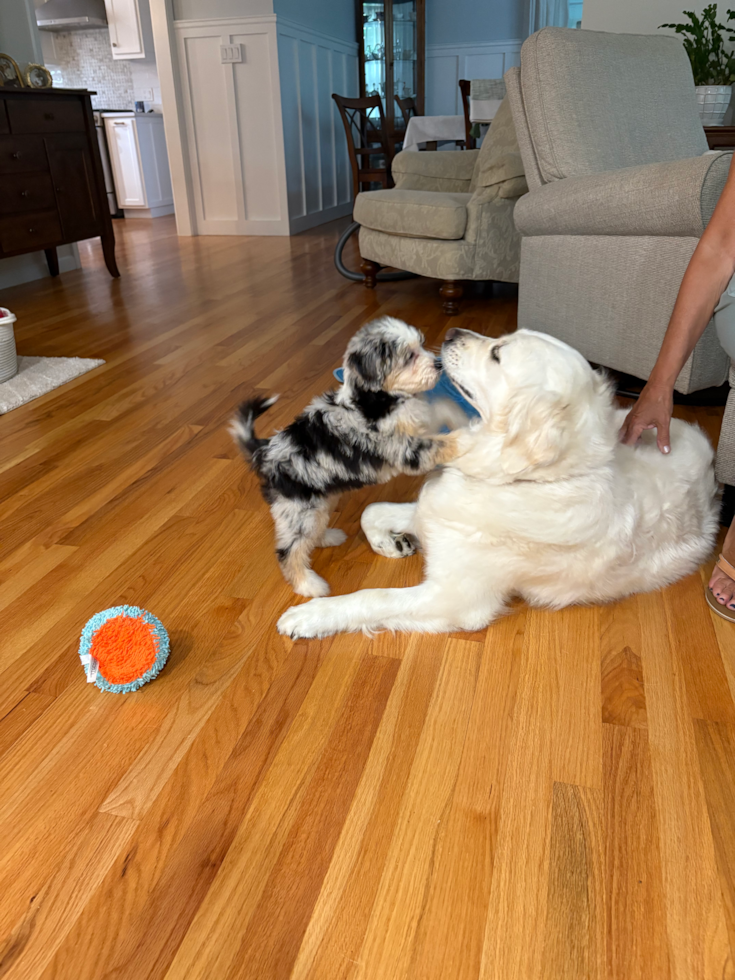
The Mini Aussiedoodle is an intelligent, observant dog that can develop an impressive understanding of household routines. Many learn to recognize the small clues that announce an activity, such as someone reaching for a leash or putting on outdoor shoes. They can be quick to respond to familiar commands and may anticipate what comes next in a game or training session. This attention makes them enjoyable companions for people who like to interact with their dogs throughout the day. It also means they appreciate clear expectations because they are quick to notice which behaviors earn a response.
One of the breed's most appealing qualities is its enthusiasm for learning. A Mini Aussiedoodle can enjoy simple obedience lessons, trick training, retrieve games, and activities that involve several steps. A dog that quickly masters a basic command may welcome a new challenge rather than endless repetitions of the same exercise. That intelligence is rewarding, but it also creates responsibility for the owner. Without suitable outlets, an individual may direct its attention toward less desirable activities such as excessive barking or attempts to control movement around the home.
Mini Aussiedoodles can also display behaviors associated with herding ancestry. Some show a particular interest in people or animals that move quickly, especially during lively games. A puppy may try to follow the movement of running children or show excitement when several people head in different directions. These behaviors vary between individuals and are not guaranteed, but they deserve thoughtful guidance when they appear. Teaching recall, calm behavior around movement, and an appropriate response to excitement can make a significant difference.
Exercise needs are an important part of the Mini Aussiedoodle temperament. Many active adults benefit from approximately 60 to 90 minutes of daily activity, with time divided between walks, games, and opportunities to use their intelligence. A longer walk may satisfy the need for movement, but a few short training sessions can provide a different kind of challenge. This breed can enjoy hikes, backyard games, and structured activities that ask it to pay attention and respond. The best routines offer variety without expecting the dog to stay busy every moment.
Affection is another important part of the Mini Aussiedoodle's personality. These dogs can develop close relationships with their families and enjoy quiet time together after an active day. Their devotion should not be confused with an inability to settle, because many learn to relax comfortably when their daily needs are met. However, a household with very little time for exercise or interaction may struggle to satisfy a particularly active individual. The Mini Aussiedoodle is most rewarding for owners who genuinely enjoy the daily involvement that comes with an intelligent, energetic companion.
Aussiechon Temperament
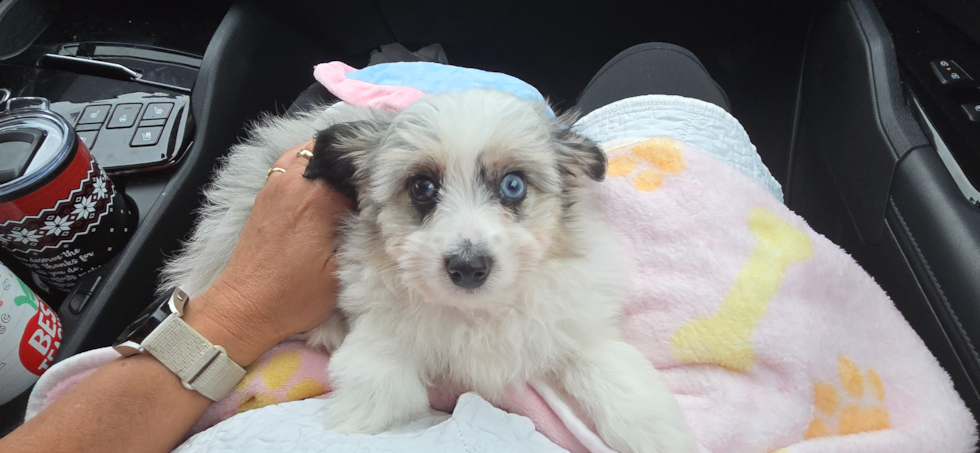
The Aussiechon has a cheerful personality that combines affection with a lively sense of fun. Many enjoy attention from familiar people and show interest in family activities without needing every moment to involve a formal task. A favorite toy, a short walk, or a playful invitation from a family member can bring out their enthusiasm. They also appreciate close companionship, whether that means a comfortable place beside someone on the couch or a quiet afternoon near the family. This balance is part of the breed's appeal for people who want an active little dog without a particularly demanding schedule.
Aussiechons are intelligent and can learn household routines quickly. Their playful nature can make reward-based training especially enjoyable, particularly when lessons feel like games. They may respond well to simple tricks, recall practice, and activities that allow them to earn praise or a favorite reward. However, a sociable Aussiechon can also lose focus when something exciting happens nearby. Early training should include calm greetings, patience around visitors, and the ability to listen even when the environment is interesting.
The Aussiechon can have a friendly, outgoing approach to people, although individual personalities vary. Some greet newcomers with immediate enthusiasm, while others need a little time to feel comfortable. Their interest in family life can make them lovely companions for children who understand how to interact gently with dogs. The breed can also do well with other pets when introductions are thoughtful and the animals have compatible personalities. Social confidence develops through positive experiences, not through breed ancestry alone.
The Aussiechon's activity needs tend to be moderate, although it is certainly not a dog that should spend every day on the couch. Around 30 to 45 minutes of walks and play can provide a useful starting point for many adults, with adjustments for more energetic individuals. These dogs enjoy games that involve their families, and many appreciate opportunities to explore new places at a comfortable pace. A short game of fetch or a few cheerful training exercises can add variety to the day. The goal is a routine that allows the Aussiechon to use its intelligence and enjoy movement without expecting the intensity associated with a highly active working-style companion.
It is important to remember that the Aussiechon still has Mini Aussie ancestry. Some individuals show strong alertness, an interest in movement, or a desire to keep track of everyone in the household. A cheerful personality does not eliminate the possibility of herding-related habits or excitement around busy activity. Consistent training and appropriate play help guide those behaviors from puppyhood. Owners who understand this side of the breed are better prepared to appreciate its cleverness without underestimating its needs.
Mini Aussiedoodle vs Aussiechon Temperament Comparison
The most important temperament difference is the level of daily activity and mental engagement each breed is likely to appreciate. The Mini Aussiedoodle tends to have a stronger drive for varied activities, training, and challenges that require concentration. An Aussiechon can enjoy those same activities but may be content with shorter sessions and a more relaxed daily schedule. This difference is useful for someone who enjoys intelligent dogs but has limited time for lengthy outings. An energetic Aussiechon can still surprise its owner, so individual temperament matters.
Training styles are similar in their foundation but can differ in emphasis. Mini Aussiedoodles may enjoy the challenge of learning several related skills and working through activities that require precision. Aussiechons frequently respond well to cheerful lessons with plenty of encouragement and opportunities to participate. Both benefit from clear rules, patience, and positive reinforcement. The Mini Aussiedoodle may ask more of an owner who wants to continue training beyond basic household manners, while the Aussiechon may fit someone whose main goal is a well-mannered family companion.
Their approach to household activity can also differ. A Mini Aussiedoodle may pay particular attention to movement and try to anticipate the next event, while an Aussiechon may show more interest in the social excitement around it. For example, a lively family gathering could encourage a Mini Aussiedoodle to monitor everyone who moves through the room, while an Aussiechon might focus on the visitors and the chance to interact. These are illustrative tendencies rather than guaranteed reactions. Both need guidance around guests, running children, and unfamiliar activity.
Families with children should think carefully about the type of play they want to encourage. A Mini Aussiedoodle can enjoy active games and training with older children who understand how to guide a dog calmly. An Aussiechon may appeal to families who prefer shorter play sessions followed by relaxed time together. Both can develop excellent relationships with children, but adult supervision and respectful handling are important. Teaching a puppy not to chase or nip at moving feet is particularly useful when herding-related behavior appears.
Apartment living is possible for either breed, although the exercise commitment differs. A Mini Aussiedoodle in an apartment will still need a substantial daily routine outside its living space, along with opportunities for training and mental activity. An Aussiechon may fit a smaller home more easily when its moderate exercise needs are met. Neither should be expected to stay quiet or relaxed without appropriate attention and training. The available time and energy of the owner matter more than the size of the home itself.
There is no need to label the Mini Aussiedoodle as difficult or the Aussiechon as effortless. Both are intelligent companions that benefit from clear communication and regular involvement with their families. The Mini Aussiedoodle simply tends to ask for more consistent activity and more opportunities to use its sharp mind. The Aussiechon may offer a more moderate pace while still providing plenty of playfulness and character. Choosing between them is largely about matching that pace to the way you enjoy spending your days.
Mini Aussiedoodle vs Aussiechon Conclusion
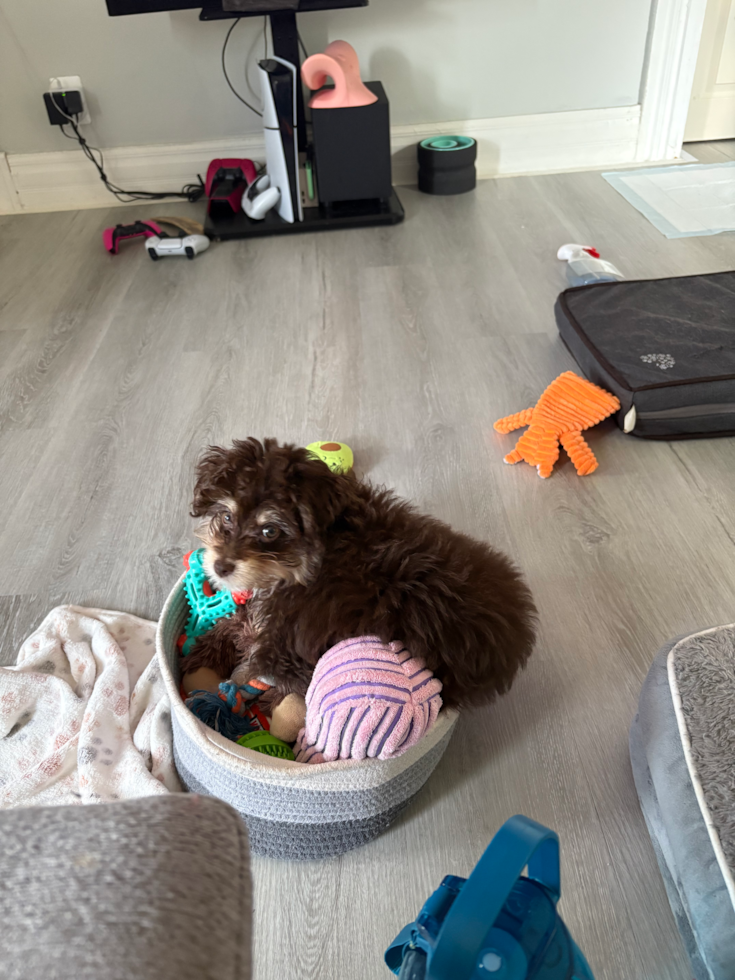
The Mini Aussiedoodle is particularly appealing to people who want an intelligent companion that can participate in an active lifestyle. If you enjoy longer walks, regular training, outdoor activities, and games that challenge your dog's mind, this breed has a great deal to offer. Its quick reactions and close attention to people can make everyday interaction especially rewarding. However, that enthusiasm deserves a reliable outlet, and the breed is less suited to a household that prefers very little daily activity.
The Aussiechon may be the better choice if you love the intelligence and striking appearance of Mini Aussie crosses but prefer a dog with more moderate exercise needs. Its cheerful personality, affectionate nature, and playful character can fit comfortably into many family routines. You should still expect regular activity, training, and opportunities for social interaction, because an Aussiechon has plenty of energy and intelligence of its own. The difference is that many Aussiechons can enjoy a fulfilling day without the same level of structured activity that an energetic Mini Aussiedoodle may prefer.
Think about what an ordinary week looks like in your home. If you already enjoy active outings and would welcome a dog that encourages you to explore, train, and try new things together, the Mini Aussiedoodle could be a wonderful match. If your days involve shorter walks, family playtime, and plenty of affectionate companionship, the Aussiechon may fit more naturally. Their similarities make both tempting, but their different activity needs should carry more weight in your decision than a particular coat color or an especially adorable puppy photograph.
Frequently Asked Questions
Is an Aussiechon a type of Mini Aussiedoodle? No, the Aussiechon and Mini Aussiedoodle are two separate designer crosses. The Mini Aussiedoodle combines a Mini Aussie with a Poodle, while the Aussiechon combines a Mini Aussie with a Bichon Frise. Their shared ancestry helps explain similarities in intelligence, coat patterns, and alertness. However, the Poodle and Bichon Frise contribute different characteristics that can influence the dogs' appearance and temperament. The two crosses should be considered individually rather than treated as different names for the same breed.
Does a Mini Aussiedoodle need a large backyard? A large backyard can be enjoyable for a Mini Aussiedoodle, but it is not essential. What matters more is the opportunity for regular exercise, training, and mental challenges. A dog with access to a big yard still needs interaction because simply opening the door does not guarantee meaningful activity. Mini Aussiedoodles can live in smaller homes when their owners provide a consistent daily routine. Someone who enjoys walks, outdoor adventures, and interactive games can offer a fulfilling lifestyle without owning a large property.
Can an Aussiechon have herding instincts? Yes, some Aussiechons can display behaviors associated with their Mini Aussie ancestry. An individual may show interest in fast movement, follow running children closely, or try to control activity through chasing or nipping. These behaviors are not guaranteed, and some Aussiechons show little interest in them. Early training can teach the dog how to respond appropriately when people or other animals move quickly. Owners should appreciate the breed's playful nature while understanding that its Mini Aussie background can still influence behavior.
Which breed is easier for a first-time dog owner, Mini Aussiedoodle or Aussiechon? The Aussiechon may be more manageable for a first-time owner who prefers moderate exercise and straightforward household training. Its affectionate, playful personality can make lessons enjoyable, particularly when rewards and encouragement are consistent. The Mini Aussiedoodle is also highly trainable, but its greater activity needs and interest in complex tasks can demand more time and involvement. A dedicated beginner with an active lifestyle can do very well with a Mini Aussiedoodle. The better choice depends on whether the owner enjoys daily training and exercise as an important part of life with a dog.
Are Mini Aussiedoodles or Aussiechons better for apartment living? Both can live in apartments, but the Aussiechon may fit the routine more easily for someone with moderate activity levels. Mini Aussiedoodles can need substantial daily exercise, so access to outdoor walking areas and time for training are important. Aussiechons still require regular walks and play, even though their typical exercise needs are lower. Both breeds can be alert to hallway noises, neighbors, and visitors, which makes early training around barking worthwhile. An apartment can suit either dog when the owner is prepared to meet its individual needs.
Can both the Mini Aussiedoodle and Aussiechon have blue eyes and merle coats? Yes, blue eyes and merle coat patterns can occur in both the Mini Aussiedoodle and Aussiechon. Their Mini Aussie ancestry makes these features possible, although not every puppy inherits them. Some dogs have two blue eyes, others have brown eyes, and a few display different colors in each eye. Merle patterns also vary considerably, with combinations of gray, black, brown, cream, and white. These features can be striking, but they do not tell you which breed will have the temperament that best suits your home.
Which breed sheds less, the Mini Aussiedoodle or Aussiechon? Both breeds can have low-shedding coats, but neither offers a guarantee of minimal shedding. Mini Aussiedoodles may inherit curly, wavy, or looser coats, and the amount of loose hair can vary with texture. Aussiechons can also have a range of coats, from plush curls to softer waves or straighter hair. Regular brushing is important for both because low shedding does not prevent tangles. If shedding is a major concern, the individual dog's coat characteristics deserve more attention than a broad claim about the breed.
Which breed is better for families that enjoy weekend hikes? The Mini Aussiedoodle may be especially appealing to families who enjoy frequent hikes and other outdoor activities. Its athletic nature and enthusiasm for movement can make it a rewarding companion on suitable trails. Aussiechons can enjoy hikes as well, particularly when the distance and pace match their individual abilities. Neither breed should be expected to handle long outings without gradual preparation and appropriate breaks. The Mini Aussiedoodle is the stronger match for a consistently active lifestyle, while the Aussiechon may appeal to families whose outings are shorter and less demanding.
Can either breed stay home alone while the family works? Both breeds enjoy companionship and should learn to spend reasonable periods alone through gradual, positive practice. A Mini Aussiedoodle may need particular attention to activity and mental engagement before and after time alone. An Aussiechon can also become restless if its day lacks interaction or a predictable routine. Puppies need more frequent breaks and supervision than adults, regardless of breed. Families with long workdays should consider how they will provide appropriate attention, activity, and opportunities for the dog to rest comfortably.
How can I choose between two puppies that seem equally playful? Look at the lifestyle you can offer rather than relying on a brief burst of puppy excitement. A Mini Aussiedoodle may be better suited to someone who enjoys daily training, longer walks, and a dog that welcomes frequent mental challenges. An Aussiechon may appeal more to someone who wants a clever, sociable companion with a moderate activity schedule. Consider how each puppy responds to familiar people, new experiences, and opportunities to settle after play. Those observations, combined with realistic breed expectations, can help you choose a companion whose personality fits your home.